~His First-Person Pronoun was Watakushi~
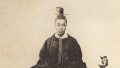
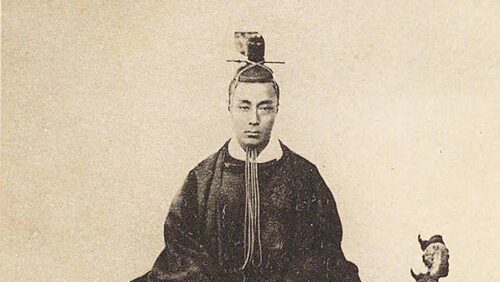
Today I introduce to you, ‘the way how THE LAST SHOGUN Tokugawa Yoshinobu(徳川慶喜) used to talk’. Tokugawa Yoshinobu is a well-known person as the last shogun of Tokugawa Bakufu (徳川幕府, Tokugawa shogunate) and also the last in the history of Japan.
The sound of the Last Shogun might give you an impression that he must have talked in such a difficult and old-fashioned (and perhaps also arrogant) way. But, surprisingly, it is presumed that he had a very familiar and friendly way to talk. This presumption is brought by the description in the book named Sekimukai Hikki (昔夢会筆記). Literally translated into English, Sekimu (昔夢) means ‘old dreams’, kai (会) ‘meeting’, hikki (筆記) ‘notes’. So, it could mean in total ‘Old Dreams Meeting Notes’. First of all, I explain to you the history and overview of the book.
This book is all about ‘memoirs of Tokugawa Yoshinobu’. In the middle of Meiji(明治) era, Shibusawa Eiichi (渋沢栄一), Yoshinobu’s former retainer and a great entrepreneur, started the activity to compile a biography of Yoshinobu for the purpose to prove his former lord’s guiltlessness of treason.1 Meanwhile, there came out the thought that they should ask Yoshinobu himself, who was still sound and alive at that time, to tell the story of his early life and the episodes in the Bakumatsu-Ishin era (幕末・維新, the end of Edo/the beginning of Meiji). They planned to hold meetings where they can ask him questions and expect correctness of the biography.2 There arose the discussion meeting Sekimukai (昔夢会), which was named by Yoshinobu himself.3
In Sekimukai, starting with Yoshinobu as the main storyteller, attended some interviewers (compilers) like Shibusawa, Ema Seihatsu (江間政発, a former retainer of Kuwana (桑名) Domain, a sinologist), who survived those old years as well as Yoshinobu, and Hagino Yoshiyuki (萩野吉之), who was one of the most famous historians at that time. Yoshinobu attended every session (17 times in total) and looked back the dramatic age of Bakumatsu-Ishin together in the way of crosstalk. Apart from these crosstalk sessions, other meetings were held 8 times, where the compilation staffs visited Yoshinobu’s residence and asked him for review and correction of the drafts.4
Shibusawa and the compilers were eager to publish the biography while Yoshinobu was still alive, but he unfortunately passed away in 1913 (Taisho 2) before the publication.5 Finally in 1918 (Taisho 7), the biography Tokugawa Yoshinobu Kō Den (徳川慶喜公伝) was published, which consists also of the contents from his own narrative in Sekimukai. 3 years earlier, in 1915 (Taisho 4), the record of dialogue in Sekimukai was also originally printed only 25 copies and distributed to those who were related to the drafts of the biography.6 This is the book called Sekimukai Hikki. Later, added a commentary by Ōkubo Toshiaki (大久保利謙), who is a historian and a grandson of Ōkubo Toshimichi (大久保利通), it was finally published. It is also a very interesting fact that an offspring of a former great opponent of Yoshinobu contributed his writings to the last Shogun’s memoir later in the history.
… Now we come back to the today’s main theme. By reading this Sekimukai Hikki, you will know (or guess) the way how Yoshinobu used to talk. The reason is as following.
In this book, the dialogues between Yoshinobu and the compilation staffs are recorded in two different parts in terms of the writing styles; one is written in literary style, and the other in colloquial style. In the former, the words spoken by Yoshinobu and others are translated into the classic Japanese.7 On the other hand, in the latter, those are recorded by stenography, which means that there you can know Yoshinobu’s spoken words as they were.
Indeed, some revision could have been made in certain points, considering the balance of the writing style in total and intelligibility for readers. However, Shibusawa himself said in the explanatory notes in the beginning of the book, ‘Because he (Yoshinobu) allowed us to use stenography, the taste of his narrative written here still makes us feel as if we were listening to his story right in front of him’8 and also ‘we preserve its original style without any revision’.9That is why I presume that the description in the colloquial part of the book is as close as possible to the way of Yoshinobu’s real speaking.
So, let us see how Yoshinobu used to talk actually. Take a look at this phrase for the first.
「この指の事はなお私が考えたが、この時に指を切ったように私は覚えている。」10 (bold-faced by the author)
“Kono yubi no koto wa nao watakushi ga kangaeta ga, kono toki ni yubi wo kitta yōni watakushi wa oboete iru.” (transformed into Roman alphabet)
“I have been thinking about it though, I remember that he cut his finger at that occasion.” (English translation)
It is very shocking from the start, but this is the very first scene in the colloquial part of this book where Yoshinobu called himself in the first-person (singular) pronoun. As you can see above, he said watakushi (わたくし, 私) calling himself. From then on, he consistently called himself so in this book. Thus, it could be thought that he used to use the word watakushi as the first-person pronoun at that time, at least when he talked in the meeting Sekimukai. Watakushi is one of the still being used first-person pronouns in Japan, although it sounds only a bit too formal in conversation comparing to watashi (わたし, 私), the most used one today.
By the way, the phrase quoted above is from the discussion between Yoshinobu and the compilers, whether Inoue Mondo-no-shō Yoshiaya (井上主水正義斐), one of the negotiators on the Bakufu side, actually cut his finger or not when he asked the representatives of foreign countries for postponement of response regarding the permission to open the port of Hyōgo.11
I presume, Yoshinobu used to use watakushi not only during Meiji era but also Edo era, in the semi-formal or casual occasions where you do not need to behave as a ruler (sometimes as a subject) by custom. Of course, actually, he presumably used various first-person pronouns for each scene. Nevertheless, you could feel Yoshinobu as a person much closer than ever.
In other scenes, he said,
「これは私の方には関係はないよ。」12 (bold-faced by the author)
“Kore wa watakushi no hō niwa kankei wa nai yo.” (transformed into Roman alphabet)
“This has nothing to do with me.” (English translation)
「板倉(勝静)が大城に行ったんだね。」13 (words in bracket, bold-faced by the author)
“Itakura (Katsukiyo) ga Daijō ni itta ndane.” (transformed into Roman alphabet)
“Itakura went to the castle.“ (English translation)
These are almost the same as the way how modern Japanese people talk in their daily casual conversation. If I try to depict it more concretely, it is very similar to the writing styles shortly after the Genbun Itchi (言文一致, unification of the spoken and written language) movement in Meiji era to be seen for instance in Botchan and I Am a Cat by Natsume Soseki (夏目漱石). I find the way of his talking very close to ours. I think you could also feel a Tokugawa Shogun so familiar.
However, in some other scenes, he talked,
「何分それは少しも聞かぬ。」14 (bold-faced by the author)
“Nanibun sore wa sukoshi mo kikanu.” (transformed into Roman alphabet)
“I have not heard of it at all.” (English translation)
「実権は持っておらぬ。」15 (bold-faced by the author)
“Jikken wa motte oranu.”(transformed into Roman alphabet)
“I had no real power.“ (English translation)
These should remind you of the typical image of samurai dramas. Like this, he also shows a glimpse of his samurai character sometimes. It might be equally quite natural because he was once the leader of all samurai actually.
As a long time goes by after the breakup of the Bakufu’s reign, the way of people’s speaking gradually changed and Yoshinobu’s social position no longer remained the same as before. Therefore, I presume that his way of speaking also slightly changed from that in the Bakumatsu era. However, considering that the way of speaking of one person does not change so drastically, I think that also in the Bakumatsu era he would talk in the similar way as written in Sekimukai Hikki. (It would be grateful if there were some historical documents which recorded his spoken words in Bakumatsu era in colloquial style, but it seems to be difficult because description in literary style was still normal in those days…)
Apropos, according to what women who served in the Ōoku in Bakumatsu era told later, the shoguns called themselves kochira (こちら, 此方) or jibun (じぶん, 自分), and the shogun’s wives (midaidokoro, 御台所) did themselves watakushi.16 Considering those facts, it is natural that Yoshinobu also called himself watakushi already in Bakumatsu era. The first-person pronouns mentioned above are all still normally used now in modern times. Thus, judging from even something as simple as the way of speaking, you can perceive that Edo era, especially Bakumatsu era, is in fact more closely connected to modern times than we imagine.
― Reading Sekimukai Hikki will make you feel as if you were also among the compilers and listening together to old grandpa Yoshinobu, who sat in front of you and were telling his story recalling the dramatic past (meanwhile, he might have got younger again for a moment).
If you are interested in the book, just browse it once. It must be lots of fun to feel deep immersion, imagining that Shibusawa, Ema and others were asking Yoshinobu questions one after another leaning forward. You will not be able to stop reading it once you started.
That’s all for this time. See you!
[Footnotes]
- Shibusawa, Eiichi. Sekimukai Hikki, Heibon-sha, 1966, front matter p.24 ↩︎
- Ibid., text p.326 ↩︎
- Ibid., front matter p.30 ↩︎
- Ibid., text p.327 ↩︎
- Ibid., front matter p.31 ↩︎
- Ibid., front matter p.3 ↩︎
- Ibid. ↩︎
- Ibid. ↩︎
- Ibid. ↩︎
- Ibid., text p.42 ↩︎
- Ibid., text pp.249-250 ↩︎
- Ibid., text p.55 ↩︎
- Ibid., text p.56 ↩︎
- Ibid., text p.49 ↩︎
- Ibid., text p.93 ↩︎
- Kyūji-Shimon-Kai; Shinji, Yoshimoto. Kyūji-Shimon-Roku—Edo Bakufu Yakunin no Shōgen—(Vol. 1), Iwanami Shoten, 1986, p.202 ↩︎
[Reference]
・Shibusawa, Eiichi. Sekimukai Hikki, Heibon-sha, 1966
・Kyūji-Shimon-Kai; Shinji, Yoshimoto. Kyūji-Shimon-Roku—Edo Bakufu Yakunin no Shōgen—(Vol. 1), Iwanami Shoten, 1986
Unauthorised reproduction or distribution prohibited.